Every part of Scholar Stack Fusion was thought through, and every part feeds one larger system. Nothing is left to chance. The aim is mastery of the concept underneath the facts. Fusion puts each idea in front of you from different angles and through as many senses as it can. Then it examines you again, a little harder each time. There are only so many ways to test a concept. By exam day, you have very likely met your question already.
AI sets new records almost every week. Benchmarks that were called impossible fall one after another. Yet most study apps still follow the same script:
Transcribe the lecture. Hand out flashcards. Recycle a fixed question bank.
That wastes the most powerful technology people have ever held. Scholar Stack Fusion asks more of it. It builds a whole study system from your lecture, and it keeps working with you until you can explain the idea, not just recognize it on a card.
Every tool is built from your own lecture, and every answer you give feeds back in. Nothing stands alone.
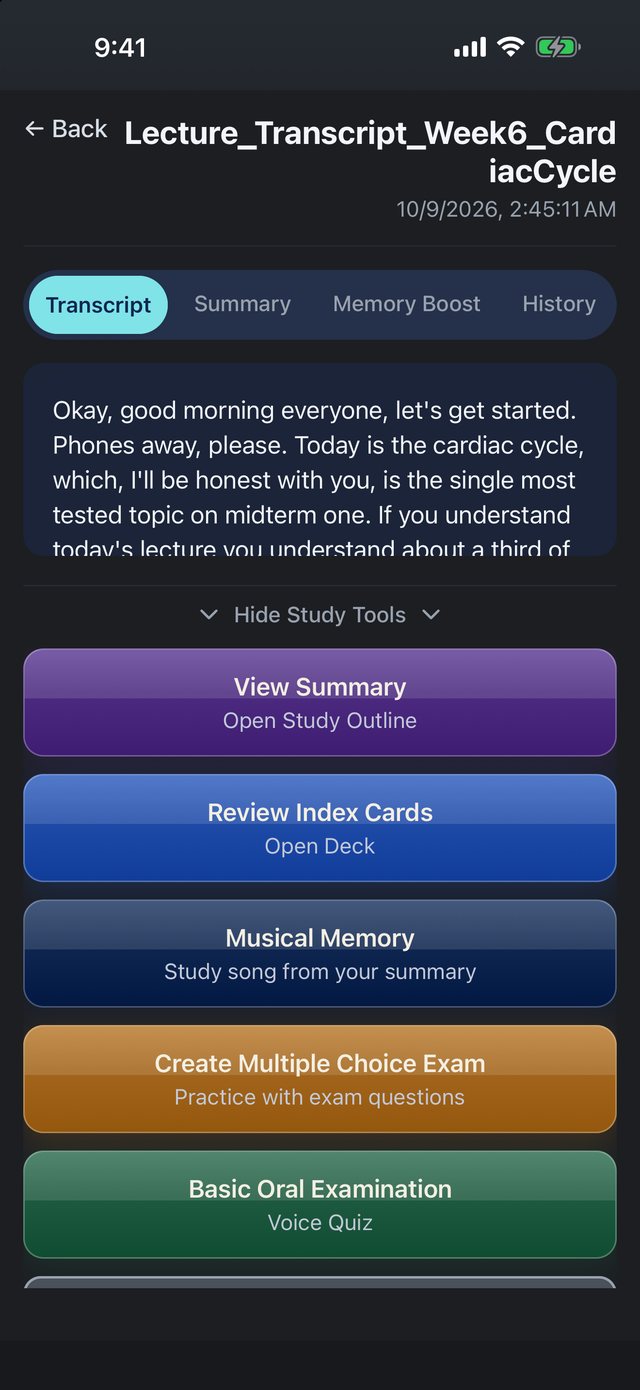
Record the lecture and transcribe it on your phone, unlimited on every plan. Or bring in PDFs, Word files, slides, web links and Canvas feeds.
Lecture capture →Fusion breaks the lecture into sections, concepts and key takeaways. Every other tool is built from this outline.
Outlines →Six memory tools at five intensity levels, plus Memeonics, AI memory pictures. You choose what to lock in, and how.
Memory Boost →Flashcards with spaced repetition. A card you know waits longer each time, up to 90 days. A card you miss comes back tomorrow.
Flashcards →Questions are written fresh, never pulled from a bank. Each key concept is tested from five different angles before any angle repeats.
Practice tests →The oral exam hands you a concept and asks you to explain it. Your answer is graded in about 3–4 seconds. Your voice is never stored.
Oral exam →Every quiz, card and spoken answer counts as evidence. Student Intelligence shows what you can explain and what you only recognize.
Student Intelligence →Exam variations retest the predicted concepts from a new angle and add the topics a prediction left out. Course Intelligence learns your professor's exam style and predicts likely questions.
How it escalates →Behind every screen, Fusion is building three models at once: one of you, one of your course and one of your professor. Every concept it finds is identified, tagged and tracked, and every answer you give adds to the record.
If your study app isn't learning about you, your course and your professor, you're leaving a lot on the table. Your classmates won't.
Fusion keeps a ledger for every lecture. It records which concepts have been tested and from which angle. Each new quiz must use an angle that concept hasn't seen yet, and the least-tested concepts go first.
Can you state it precisely?
Can you use it to solve something?
Can you spot it in a new situation?
Where does it bend or break?
How does it connect to the rest?
Knowing it at your desk is one thing. Producing it with a clock running and nothing in front of you is what the exam asks for. Fusion puts you in that situation on purpose, again and again, so the real thing feels familiar.
One concept, 25 seconds to think. Then the microphone starts on its own and you have 60 seconds to explain it. No notes, no second try.
Sit a quiz under exam conditions: 90 seconds a question, with the clock on screen and the last minute flagged.
Course Intelligence studies how your professor tests, then writes a mock exam in that style. Fusion plan.
Retest the same concepts from a new angle, or pull in the topics the last exam left out. The bar keeps rising.
We believe an idea you have heard, seen, written and said out loud builds stronger, longer-lasting memory than one you have only read. So Fusion gives every concept as many ways in as it can, then examines it again through each of them. One framework, many senses, constant re-examination.
Replay the lecture beside its transcript, or listen to a short recap of what matters.
Turn a concept into a picture you will remember. See how the ideas connect.
A proofread transcript and an outline you can edit, or translate into another language.
Answer in your own words. Fusion grades what you meant, not whether the words match.
Explain it out loud. For a full live conversation, talk it through with Dynamic.
A whole lecture set to music, with the tested terms on the rhyme. Fusion plan.
Fusion builds your study material. Dynamic tutors and examines you on it. Fusion members can hand their learning profile to Dynamic.
Record once. Fusion gives you the transcript, the outline, flashcards, practice quizzes, an oral exam and memory aids, all from your own material.
Real-time voice tutoring and oral exam practice. Work from your own notes or just a topic. Dynamic scores eight dimensions while you talk, then gives you a Session Report.
Board exams don't ask what you highlighted. They ask what you can produce, under pressure, with nothing in front of you.
Scholar Stack was designed by a physician who has been through the testing, years of it. He knows what relentless studying looks and feels like: the lecture you can't afford to miss, the stack of material that never gets smaller, the exam that decides what you get to do next.
That is why it is built the way it is. Quizzes that refuse to repeat themselves, because he watched people memorize the question instead of the concept. An oral exam, because explaining it out loud is the test that tells the truth. A memory engine, because at some point there are more facts than there is time.
The founder · physician, and the app's first userThe Free plan also includes 60 minutes of cloud transcription and 4 outlines a month. Pro is $9.99/month or $79.99/year. Fusion is $19.99/month or $149.99/year and adds study songs and the intelligence features.
Starter: 30 minutes for $9.99/month. Scholar: 75 minutes for $19.99/month. Honors: 180 minutes for $39.99/month. Every plan has the same features. Only the minutes differ.